
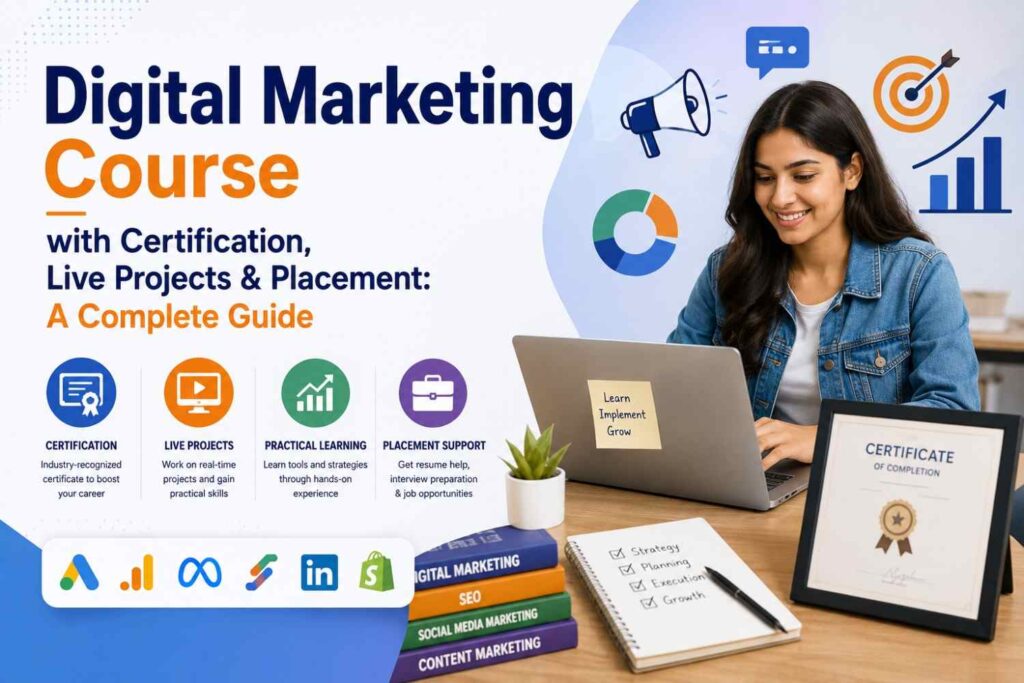
Digital marketing has become an essential part of modern business growth, creating opportunities for students, freshers, working professionals, and entrepreneurs. However, simply learning digital marketing concepts may not be enough to build a successful career. Employers increasingly look for candidates who have practical skills, recognized credentials, and an understanding of real-world marketing campaigns.
Choosing a digital marketing course with placement can help learners develop industry-relevant skills while receiving career guidance. Similarly, a digital marketing certification can validate your knowledge, while a digital marketing course with live projects can provide practical exposure before entering the workforce.
This guide explains what these three components mean, why they matter, what you should learn, and how to choose the right course for your career goals.
Businesses today depend heavily on online channels to attract customers, generate leads, increase sales, and build brand awareness. This has created demand for professionals who understand search engines, social media, paid advertising, content, analytics, and other digital channels.
A structured digital marketing can help you develop skills across areas such as:
Instead of learning these skills randomly through different online resources, a structured program can provide a systematic learning path from fundamentals to practical implementation.
A digital marketing certification provides learners with a formal certificate after completing the required training or assessment. Certification can demonstrate that you have completed a structured learning program and developed knowledge of important digital marketing concepts.
However, a certificate should not be the only factor you consider when selecting a course.
A valuable certification program should be supported by:
For freshers, certification can strengthen a resume, particularly when combined with practical projects and demonstrable skills.
Knowing the theory behind SEO or social media marketing is different from actually implementing a campaign. This is why practical experience plays an important role in digital marketing education.
A digital marketing course with live projects allows learners to apply concepts to realistic marketing situations. Depending on the course structure, projects may involve activities such as keyword research, website optimization, social media planning, content creation, paid advertising, analytics, or campaign reporting.
Live projects can help students:
For example, instead of simply learning what SEO is, a practical project may require you to conduct keyword research, optimize a webpage, create an internal linking strategy, and analyze performance.
This type of experience can make the transition from classroom learning to professional work easier.
A digital marketing placement generally combines training with career-oriented support. Placement assistance may include resume development, interview preparation, job alerts, mock interviews, career counseling, and assistance in connecting qualified learners with relevant employment opportunities.
It is important to understand that “placement assistance” and a guaranteed job are not necessarily the same thing. Before enrolling, ask the institute exactly what placement support includes.
A strong career-support program may include:
The goal should be to make you employable rather than simply provide a certificate.
A well-structured program should cover both fundamental marketing concepts and practical execution.
SEO teaches you how websites can improve their visibility in search engines. You may learn keyword research, on-page SEO, technical SEO, link building, local SEO, content optimization, and performance analysis.
Social media training can cover content planning, audience research, platform strategies, social media advertising, engagement, and campaign measurement.
Learners can understand how paid campaigns work across search and social platforms, including campaign structure, audience targeting, keyword selection, ad creation, budgeting, and performance analysis.
Content remains an important part of digital marketing. Students can learn how to research topics, create useful content, optimize it for search intent, and align content with business objectives.
Digital marketers need to understand data. Analytics training can help learners evaluate website traffic, user behavior, conversions, campaign performance, and other important marketing metrics.
Artificial intelligence is increasingly being used for research, content ideation, automation, data analysis, personalization, and campaign optimization. Learning how to use AI responsibly can help marketers work more efficiently while still applying human judgment and strategic thinking.
With many training options available, choosing the right program requires more than comparing course fees.
Consider the following factors before enrolling.
Check whether the curriculum covers the areas you want to learn. A good program should balance fundamentals, advanced concepts, tools, and practical implementation.
Ask whether the course includes assignments, case studies, simulations, or live projects. Practical exposure can significantly improve your learning experience.
Find out who provides the certification, what requirements you need to complete, and whether assessments are included.
Ask what career support is actually provided. Look for transparent information about resume support, interviews, job assistance, and career counseling.
Experienced trainers can explain concepts using practical examples and help students understand how marketing strategies are implemented in professional environments.
A portfolio can be useful when applying for entry-level digital marketing roles. Projects, campaign reports, SEO audits, content plans, and other practical work can demonstrate your capabilities to potential employers.
Athenax Academy focuses on career-oriented digital marketing education designed to help learners develop practical and industry-relevant skills. Its training approach can help students understand important digital marketing channels while working on practical assignments and projects.
For learners looking for a digital marketing placement, the focus should be on developing employable skills alongside career preparation. Combining certification, practical projects, and career support can provide a more complete learning experience.
Digital marketing training can be suitable for a wide range of learners, including:
You do not necessarily need a technical background to begin. A willingness to learn, practice, analyze results, and stay updated with changing digital trends is often more important.
Digital marketing is a continuously evolving field, so career preparation should go beyond completing lessons. A combination of structured learning, practical projects, certification, portfolio development, and career guidance can help you build a stronger foundation.
Whether your goal is to become an SEO professional, social media marketer, paid advertising specialist, content marketer, or full-stack digital marketer, choosing the right training program can make your learning journey more focused.
Athenax Academy can be explored by learners looking for structured digital marketing education, practical exposure, certification, and career-oriented support. The right course is ultimately one that helps you learn the concepts, implement them through projects, measure results, and confidently apply your skills in the real world.
Frequently Asked Questions –
Yes. Freshers can benefit from structured training, practical projects, resume development, interview preparation, and career guidance. However, learners should verify what placement assistance actually includes before enrolling.
Certification can demonstrate that you have completed structured training, but it is only one part of your profile. Practical experience, portfolio projects, communication skills, and the ability to execute campaigns are also important.
Live projects allow you to apply theoretical concepts to practical marketing situations. They can help you understand tools, campaign execution, reporting, optimization, and problem-solving while building portfolio material.
Yes. Beginners can start with fundamental concepts such as SEO, social media marketing, content marketing, paid advertising, and analytics before progressing toward advanced strategies.
The learning period depends on the curriculum, course format, and time you dedicate to practice. Basic concepts can be learned relatively quickly, but developing professional-level skills requires continuous practice and experience.
Review the curriculum, practical training, live projects, certification, trainer experience, tools covered, assessments, portfolio opportunities, and placement assistance. Also check whether the program matches your specific career goals.

Mr. Govind Chandak At AthenaX , we know that you can learn a lot from good people. We feel good to have Govind Chandak with us. He is a well-known Digital Marketing Trainer and Growth Strategist. He has worked in many places around the world. He is here to share all that he knows with our group.