Artificial intelligence has quickly become an important part of modern digital marketing. Marketers are using AI to research audiences, create content, analyze data, optimize advertising campaigns, communicate with customers, and automate repetitive marketing activities.
AI does not necessarily replace the role of a digital marketer. Instead, it can help marketers work more efficiently by reducing the time required for repetitive tasks and providing additional insights during research, planning, and optimization.
For students and professionals, understanding how different AI tools work can provide valuable practical knowledge. However, learning the purpose and application of each tool is more important than simply collecting a long list of software names.
If you are searching for a digital marketing institute in Nagpur, consider whether the course provides practical exposure to AI-powered marketing tools along with fundamental digital marketing concepts.
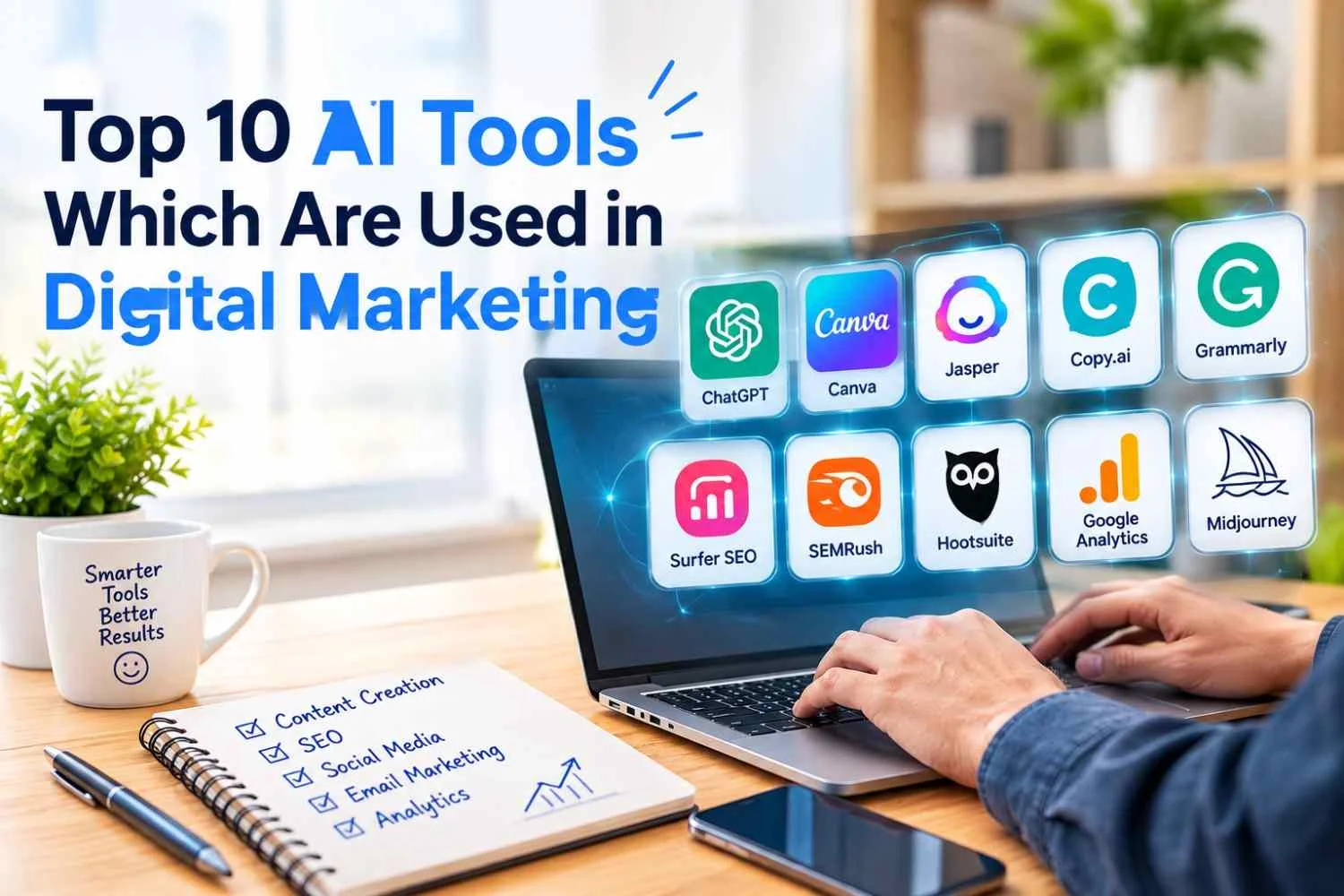
Here are ten important categories of AI tools that modern digital marketers should understand.
Generative AI assistants are among the most widely used AI technologies in digital marketing. They can help marketers brainstorm ideas, organize research, create content outlines, summarize information, develop campaign concepts, and generate different versions of marketing copy.
Popular examples include ChatGPT, Google Gemini, and Claude.
A digital marketer can use these tools for activities such as:
For example, an SEO professional could provide a target keyword and audience description to an AI assistant and ask it to generate potential content angles. The marketer can then evaluate those ideas against search intent and business goals.
AI-generated content should not automatically be treated as final content.
Marketers need to verify facts, add original insights, check the tone, remove unnecessary information, and ensure that the final content provides genuine value to the audience.
The most effective approach is to use AI as an assistant rather than allowing it to make every marketing decision.
Content marketing requires a continuous flow of ideas and assets. Marketers may need blog posts, social media captions, advertisements, email campaigns, product descriptions, landing-page copy, and video scripts.
AI-powered content platforms can help accelerate different stages of this process.
Some commonly known tools include Jasper, Copy.ai, Writesonic, and Grammarly’s AI features.
These platforms can help marketers with:
For example, a marketer could create a long-form blog and then use AI to develop shorter social media posts based on the same core information.
AI should support the creative process rather than completely replace human creativity.
A marketer should add:
This makes the final content more useful and differentiated.
AI can make content creation faster, but understanding the audience and creating a meaningful message remains the marketer’s responsibility.
Search engine optimization is another area where AI is becoming increasingly useful.
SEO professionals can use AI-powered tools to assist with keyword research, content optimization, search-intent analysis, topic clustering, content briefs, competitor research, and website analysis.
Popular SEO platforms that incorporate AI or AI-assisted features include Semrush, Ahrefs, Surfer SEO, Frase, and SE Ranking.
For example, an SEO professional can use these platforms to investigate:
AI can help identify patterns across large amounts of information, but SEO decisions should still consider search intent, website quality, technical performance, content usefulness, user experience, and the overall business objective.
Someone learning SEO should understand how search engines work, how keywords relate to user intent, how websites are structured, and how content and technical factors influence organic visibility.
AI tools can make SEO workflows faster, but they are most useful when operated by someone who understands SEO fundamentals.
Social media marketing requires regular planning, content creation, publishing, engagement, and performance analysis.
AI-powered social media tools can help marketers manage these activities more efficiently.
Platforms such as Hootsuite, Buffer, Sprout Social, and Canva offer features that can support content planning, scheduling, creative development, or social media analysis.
AI can help marketers generate:
For example, a marketer launching a new product could use AI to develop multiple social media concepts for Instagram, Facebook, LinkedIn, and other platforms.
However, each platform has different audiences and communication styles. A successful marketer should adapt the content instead of publishing exactly the same AI-generated message everywhere.
Social media is not only about publishing content. It also involves community building, responding to customers, understanding conversations, and creating authentic brand experiences.
AI can support these activities, but human interaction remains an important part of social media marketing.
Online advertising platforms increasingly use machine learning and AI to help advertisers with targeting, bidding, creative optimization, and campaign performance.
Google Ads provides AI-powered features that can assist advertisers with campaign optimization, targeting, bidding, and other activities. Meta Advantage+ also uses automation and machine learning across various advertising processes.
Other platforms and tools can assist marketers with advertising research, creative development, and campaign analysis.
AI can support:
However, marketers still need to understand fundamental PPC concepts.
These include:
AI automation becomes much more useful when a marketer understands the fundamentals behind the campaign.
Data analysis is one of the most important parts of digital marketing.
Marketers collect information from websites, advertising platforms, social media channels, CRM systems, email platforms, and analytics tools.
AI can help marketers organize and interpret large quantities of information more efficiently.
Tools such as Google Analytics 4, Microsoft Power BI, Tableau, and AI-assisted spreadsheet or analytics features can support different parts of marketing analysis.
For example, a marketer might investigate:
AI can help summarize data and identify patterns, but marketers should always verify conclusions against the original analytics information.
Knowing how to use an AI tool is not the same as knowing how to analyze marketing data.
A good digital marketer should understand metrics such as:
Combining data knowledge with AI can make marketing analysis significantly more efficient.
Email marketing is another area where AI can improve productivity.
Platforms such as Mailchimp, HubSpot, and ActiveCampaign provide automation and AI-supported capabilities that can assist marketers with different aspects of email campaigns.
AI can help marketers develop:
For example, an online business could divide customers into different groups based on their interests or previous interactions and develop more relevant communication for each segment.
Personalization can make email communication more relevant, but marketers should avoid unnecessary or excessive communication.
The objective should be to provide the right message to the right audience at the appropriate stage of the customer journey.
AI can assist with this process, but marketers need to understand customer behavior and campaign objectives first.
AI chatbots are becoming increasingly useful for businesses that receive frequent customer questions or generate leads through websites.
Tools such as Tidio, HubSpot, Intercom, and other conversational AI platforms can support customer communication, lead qualification, basic support, and website engagement.
A chatbot can help answer questions about:
For digital marketers, chatbots can become an important part of lead-generation and conversion strategies.
For example, a website visitor may have a question about a digital marketing course. Instead of leaving the website, the visitor could interact with a chatbot and receive information about available programs or request contact from the business.
A useful chatbot should:
The goal should be to improve the customer experience rather than simply automate conversations.
Visual content is essential for modern digital marketing.
Marketers need graphics for websites, advertisements, social media, blogs, presentations, email campaigns, and video content.
AI-powered creative platforms such as Canva, Adobe Firefly, and other AI-assisted design tools can help marketers develop visual concepts and speed up basic design workflows.
These tools can assist with:
For example, a marketer can create one campaign concept and adapt the visual for different social media dimensions.
However, marketers should maintain consistent branding across all creative assets.
Important considerations include:
AI can accelerate design work, but marketers still need basic visual communication skills.
Marketing automation connects different marketing activities and reduces repetitive manual work.
Tools such as Zapier, Make, HubSpot, and other automation platforms can help businesses connect applications and create automated workflows.
For example, when someone submits a lead form, an automation workflow could potentially:
AI can make these workflows more intelligent by helping categorize information, generate responses, summarize customer interactions, or support decision-making.
Learning marketing automation can be particularly useful for professionals working in lead generation, performance marketing, CRM management, and growth marketing.
Digital marketing is continuously evolving. Businesses increasingly expect marketers to understand both established marketing channels and emerging technologies.
A student attending a digital marketing institute in Nagpur can benefit from practical exposure to AI because it introduces modern workflows alongside established marketing concepts.
Instead of simply memorizing the names of tools, students should learn how to solve marketing problems using technology.
For example, a practical project could involve:
This approach helps students understand how different tools can work together as part of a complete marketing workflow.
Simply watching tutorials about AI tools is not enough. Practical application is important.
Start with the fundamentals of:
Understanding these areas helps you recognize where AI can provide value.
You do not need to learn every AI platform available.
Choose tools based on your career interest.
For example:
SEO: Semrush, Ahrefs, Surfer SEO
Content: ChatGPT, Gemini, Jasper, Copy.ai
Design: Canva, Adobe Firefly
Social Media: Hootsuite, Buffer
Analytics: GA4, Power BI
Automation: Zapier, Make
CRM and marketing: HubSpot
Create practical projects such as:
Projects help you understand how tools work in realistic situations.
Always check AI-generated information for:
AI can make mistakes, so human review remains essential.
Marketing should ultimately be connected to measurable outcomes.
Use analytics and performance metrics to determine whether your activities are generating:
The purpose of AI is not simply to produce more content or automate more tasks. The objective is to improve marketing effectiveness.
If you are planning to learn digital marketing, look beyond the number of tools mentioned in a course brochure.
A useful program should ideally cover core marketing concepts as well as modern technologies.
Look for exposure to:
Practical experience is especially valuable because knowing the name of an AI tool is very different from knowing how to apply it to a real marketing challenge.
AthenaX Academy focuses on practical digital marketing learning and incorporates modern AI-focused concepts to help students understand how technology can be applied to today’s marketing workflows.
AI is no longer limited to technology companies or specialized technical roles. It is becoming increasingly relevant to everyday digital marketing activities, including SEO, content creation, social media, advertising, analytics, customer engagement, design, email marketing, and automation.
Tools such as ChatGPT, Google Gemini, Claude, Semrush, Ahrefs, Canva, Google Ads, Meta Advantage+, HubSpot, Tidio, Zapier, and Make represent different parts of the modern AI-assisted marketing ecosystem.
However, learning ten or twenty tools is not enough.
The more valuable skill is understanding which tool to use, when to use it, how to evaluate its output, and how to connect it with a broader marketing strategy.
When choosing a digital marketing institute in Nagpur, students should consider programs that combine digital marketing fundamentals with practical projects, analytics, AI applications, and hands-on exposure to modern marketing workflows.
With consistent practice, responsible AI usage, and a strong understanding of marketing fundamentals, aspiring marketers can develop skills that remain useful as the digital marketing industry continues to evolve.
AI is changing how marketers work, and learning these tools alongside core digital marketing skills can help you understand the modern marketing ecosystem more effectively.
If you want to learn SEO, social media marketing, Google Ads, performance marketing, analytics, Generative AI, and other modern digital marketing skills, consider joining AthenaX Academy for practical, career-focused learning.
Build your marketing knowledge, practice with modern tools, work on practical projects, and develop skills that can help you move toward a career in the digital marketing industry.
Join AthenaX Academy and start building your digital marketing and AI skills today.
📞 Call AthenaX Academy: +91 96658 40973
Contact the AthenaX Academy team to learn about the latest course details, upcoming batches, and enrollment options.
AI tools can help marketers improve productivity, generate ideas, analyze information, automate repetitive activities, and support content and campaign development. They can be useful across SEO, social media, advertising, analytics, email marketing, and automation.
Popular tools and platforms include ChatGPT, Google Gemini, Claude, Semrush, Ahrefs, Surfer SEO, Canva, Adobe Firefly, Google Ads, Meta Advantage+, HubSpot, Mailchimp, Tidio, Zapier, and Make. The appropriate tool depends on the specific marketing task.
Many AI tools are designed to be relatively easy to use. However, beginners need to learn how to give useful instructions, evaluate AI-generated output, and apply the tool to actual marketing objectives.
AI can automate or accelerate certain SEO activities, but SEO professionals are still needed for strategy, technical decisions, search-intent evaluation, website analysis, content quality, and business-focused recommendations.
No. Learning every tool is unnecessary because new AI platforms and features are introduced frequently. It is generally more useful to understand a smaller group of relevant tools thoroughly and learn how to apply them to real marketing problems.
Students can create practical projects involving SEO research, content planning, social media calendars, advertising campaigns, analytics reports, chatbot workflows, email campaigns, and marketing automation.
Look for a program that covers core digital marketing disciplines, practical projects, analytics, AI tools, modern marketing workflows, and career-oriented skills. Hands-on learning can help students understand how marketing tools are used in real situations.
Yes. AI can help small businesses with content ideas, customer communication, basic automation, social media planning, advertising support, research, and data analysis. Businesses should still review AI-generated outputs and maintain appropriate human oversight.

Mr. Govind Chandak At AthenaX , we know that you can learn a lot from good people. We feel good to have Govind Chandak with us. He is a well-known Digital Marketing Trainer and Growth Strategist. He has worked in many places around the world. He is here to share all that he knows with our group.