Artificial intelligence is changing the way digital marketers research audiences, create content, analyze data, manage campaigns, and automate repetitive tasks. From generating content ideas to identifying patterns in marketing data, AI tools are helping professionals complete many everyday activities more efficiently.
However, AI is not a replacement for digital marketing fundamentals. Successful marketers still need creativity, strategic thinking, communication skills, customer understanding, analytical ability, and knowledge of SEO, social media, advertising, and analytics.
For students, freshers, entrepreneurs, and working professionals considering a digital market course with ai in nagpur, understanding the most useful AI tools and their practical applications can provide a strong foundation for the future of marketing.
Digital marketing involves many activities that can consume significant amounts of time. Keyword research, content planning, competitor research, campaign ideas, reporting, audience analysis, email creation, and social media planning can all involve repetitive work.
AI can help marketers accelerate these processes while allowing them to spend more time on strategy and decision-making.
Depending on the task, marketers can use AI to:
The important point is that AI should work as a productivity and decision-support tool. Marketers should still review information, verify facts, maintain brand consistency, and make the final strategic decisions.
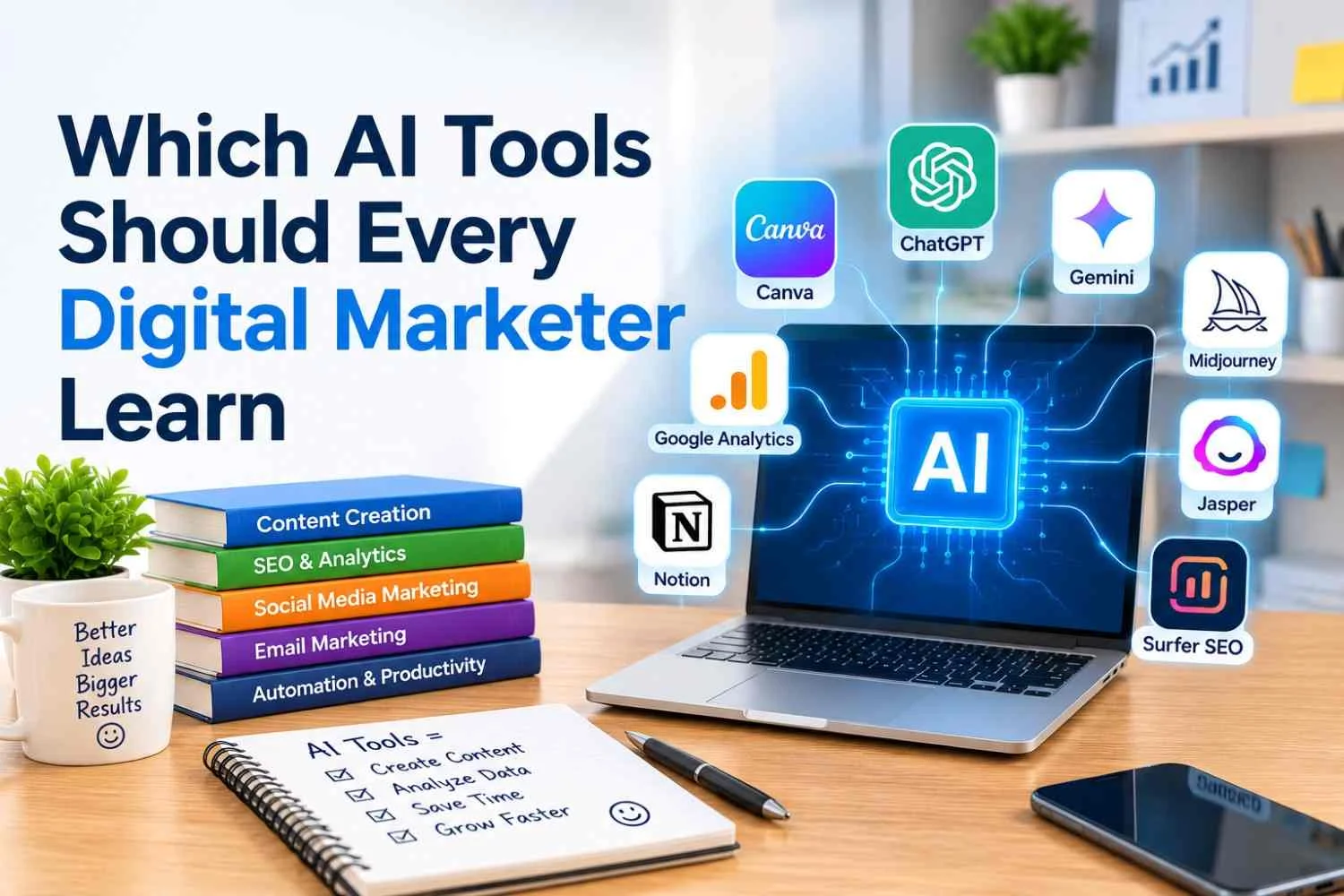
Generative AI tools are among the most important technologies for modern marketers. Platforms such as ChatGPT, Google Gemini, and Claude can support brainstorming, content planning, research assistance, campaign concepts, copy variations, and workflow development.
For example, a marketer could use a generative AI tool to create:
The output should not simply be copied and published. Marketers should review AI-generated content for accuracy, originality, relevance, tone, and audience value.
One of the most useful AI skills for marketers is prompt writing.
Instead of asking an AI tool a broad question, marketers can provide context about the target audience, marketing objective, brand voice, product, location, keywords, and desired output.
Better prompts generally provide more useful results.
This makes prompt engineering and AI-assisted workflow design valuable skills for people entering modern digital marketing careers.
Content creation is another area where AI can improve productivity. Marketers can use AI-powered platforms to brainstorm topics, prepare outlines, develop first drafts, create social media variations, and generate content briefs.
Tools such as ChatGPT, Gemini, Canva’s AI features, and other content-focused platforms can assist with different parts of the creative process.
However, good content still requires human input.
AI can generate text quickly, but it does not automatically understand every audience, business objective, customer emotion, or brand personality.
A marketer must determine:
The strongest content strategy combines AI efficiency with human creativity, research, editing, and strategic thinking.
AI is also becoming increasingly useful for search engine optimization. SEO professionals can use AI to support keyword research, search-intent analysis, content ideation, content briefs, internal linking ideas, and technical SEO research.
AI can help an SEO professional organize large amounts of information and identify potential areas that deserve further investigation.
However, AI should not replace SEO expertise.
Marketers still need to understand:
SEO tools such as Semrush, Ahrefs, Google Search Console, and other platforms can be combined with AI-assisted workflows to make research and analysis more efficient.
Social media marketers often need to create large volumes of content across multiple platforms. AI can help generate post ideas, caption variations, content-calendar concepts, campaign themes, and audience-focused messaging.
For example, a marketer managing Instagram, Facebook, LinkedIn, and YouTube can use AI to adapt one campaign idea into different formats for different audiences.
AI can also help marketers analyze engagement patterns and identify content themes worth exploring further.
However, automation should not remove authenticity from social media.
Brands still need genuine communication, community engagement, creative storytelling, and timely responses to customers.
AI is increasingly integrated into digital advertising platforms and marketing workflows. Marketers can use AI-assisted tools to develop ad concepts, generate creative variations, analyze campaign information, and identify opportunities for optimization.
AI can support activities related to:
But marketers still need a strong understanding of paid advertising fundamentals.
They should know how to define campaign objectives, select audiences, manage budgets, track conversions, evaluate performance metrics, and optimize landing pages.
AI can accelerate the process, but marketers need to understand what the numbers mean before making decisions.
Digital marketing produces a huge amount of data from websites, advertising platforms, social media, CRM systems, and analytics tools.
AI can help marketers organize and interpret this information more efficiently.
For example, an AI-assisted workflow can help a marketer investigate:
However, AI-generated interpretations should always be checked against the original data.
Understanding Google Analytics 4, conversion tracking, campaign metrics, customer journeys, and basic data analysis remains essential for marketers.
Email marketing is another area where AI can support productivity and personalization.
Marketers can use AI to generate subject-line ideas, email variations, campaign concepts, audience-specific messages, and content ideas.
AI can also assist with organizing different customer segments and developing personalized communication concepts.
However, personalization should be meaningful. Sending large amounts of automatically generated content does not necessarily create better customer experiences.
Marketers should focus on relevance, timing, value, and customer intent.
Marketing automation can reduce repetitive manual work and help businesses manage customer journeys more efficiently.
AI-powered workflows can assist with activities such as:
Understanding AI automation is becoming particularly useful for marketers working in lead generation, performance marketing, CRM management, and growth marketing.
This is also where marketers can begin moving from simply using AI tools to designing complete AI-powered marketing workflows.
Modern marketers also need to understand how AI can support visual content.
Platforms such as Canva and other AI-assisted design tools can help marketers create social media graphics, presentations, campaign visuals, thumbnails, and other marketing assets.
These tools can reduce the time required for initial design concepts.
However, marketers should still understand basic design principles such as:
AI can accelerate design production, but marketing communication still requires human judgment.
If you are searching for a digital market course with ai in nagpur, look for a program that teaches AI alongside core digital marketing concepts rather than treating AI as an isolated subject.
A practical learning path can include:
This approach helps beginners understand not only which AI tools exist, but also when, why, and how to use them in real marketing situations.
AthenaX Academy’s curriculum combines digital marketing training with AI-focused learning, including Generative AI and Agentic AI concepts, while its broader programs cover SEO, social media, advertising, analytics, content marketing, and practical projects.
Learning AI tools alone is not enough to become a successful digital marketer.
You should also develop:
Learn how to interpret campaign and website data rather than simply asking AI to explain it.
Marketing involves communicating ideas clearly through content, advertisements, emails, presentations, and social media.
AI can generate ideas, but marketers need to identify which ideas are relevant, original, and valuable.
Understand business objectives, target audiences, customer journeys, positioning, and conversion goals.
Learn how to collect information, evaluate sources, understand customers, and identify market opportunities.
Marketing campaigns rarely perform perfectly from the beginning. Marketers need to identify problems, test solutions, and continuously optimize campaigns.
Before enrolling in a course, consider whether the program provides exposure to both marketing fundamentals and modern AI applications.
A useful course should ideally provide opportunities to learn:
Practical experience is especially important because knowing the name of an AI tool is very different from knowing how to apply it to a real marketing problem.
AI is becoming an important part of modern digital marketing. From content creation and SEO to social media, paid advertising, data analysis, email marketing, design, and automation, AI tools can help marketers improve productivity and develop more efficient workflows.
However, successful AI marketing is not simply about using as many tools as possible. Marketers need to understand the fundamentals of marketing and use AI where it can provide meaningful value.
For students and professionals considering a digital market course with ai in nagpur, the ideal approach is to develop traditional digital marketing skills alongside practical AI capabilities. This combination can help learners understand both the strategic and technological sides of modern marketing.
Frequently Asked Questions –
Beginners can start with general-purpose generative AI tools such as ChatGPT, Gemini, or Claude, followed by AI-assisted tools for SEO, content creation, design, analytics, and automation. The most useful tools depend on the marketer's specific role and workflow.
AI knowledge is increasingly useful for digital marketers because it can support research, content creation, analysis, advertising, social media, and automation. However, AI should complement rather than replace fundamental marketing knowledge.
AI can automate or accelerate certain marketing tasks, but digital marketing still requires strategy, creativity, customer understanding, communication, critical thinking, and decision-making. Human oversight remains important when evaluating AI-generated information and marketing outputs.
Yes. AI can support keyword research, content planning, search-intent analysis, content briefs, internal linking ideas, and SEO research. However, SEO professionals still need to evaluate website quality, technical factors, search intent, content usefulness, and overall search performance.
Learning digital marketing fundamentals first can make AI much easier to understand and apply. Once you understand SEO, advertising, content, social media, analytics, and customer journeys, you can identify where AI can improve your workflows.
AI skills can complement traditional digital marketing knowledge and help professionals work more efficiently. Practical experience, analytical ability, communication, strategic thinking, and knowledge of marketing fundamentals remain important for long-term career development.
If you want to develop practical digital marketing skills while learning how AI can be applied to modern marketing workflows, join the Digital Marketing Course at AthenaX Academy.
Learn essential areas such as SEO, social media marketing, paid advertising, analytics, content marketing, Generative AI, and AI-powered marketing workflows through a career-focused learning approach.
Start your digital marketing and AI journey today.
📞 Call AthenaX Academy: +91 96658 40973
Speak with the AthenaX Academy team to learn about the latest course details, upcoming batches, and enrollment options.

Mr. Govind Chandak At AthenaX , we know that you can learn a lot from good people. We feel good to have Govind Chandak with us. He is a well-known Digital Marketing Trainer and Growth Strategist. He has worked in many places around the world. He is here to share all that he knows with our group.